

A Complete Guide to PTC Ceramic Heaters: Principle, Pros & Cons, and Industrial Standards
Table of Contents
-
Core Principle of PTC Heaters
-
Advantages and Disadvantages of PTC Ceramic Heaters
-
Industrial Standards for PTC Heaters
-
Selection Guide and Application Examples
-
Frequently Asked Questions (FAQ)
1. Core Principle of PTC Heaters
PTC stands for Positive Temperature Coefficient. The core of a PTC heater is a special semiconductor ceramic material whose operation is based entirely on its unique resistance-temperature characteristic.
Core Operating Mechanism:
-
Low-Temperature, High-Efficiency Heating Phase: When the temperature is below its preset "Curie Point", the PTC ceramic element has very low electrical resistance, allowing a large current to pass through. This results in high heating power for rapid temperature rise.
-
Intelligent Constant-Temperature Regulation Phase: When the temperature reaches or exceeds the Curie Point, its electrical resistance increases dramatically (often by several orders of magnitude). This causes the current to drop sharply, and the heating power automatically decreases significantly.
-
Dynamic Equilibrium: If the temperature drops slightly below the Curie Point due to heat dissipation, the resistance decreases, power increases, and the temperature rises again. This cycle repeats, creating a dynamic equilibrium around the set temperature point.
In simple terms: A PTC heater acts like a heating device with a built-in smart thermostat. Its revolutionary advantage over traditional fixed-resistance wire heaters is its ability to automatically stabilize its own temperature within a specific range without the need for external complex temperature control circuits.
Illustration:
Heating Process:
Low Temp (T < Curie Point) -> Low Resistance -> High Current -> **High Power Heating** -> Temp Rises
Temp Reaches Balance Point (T ≈ Curie Point) -> Resistance Soars -> Current Plummets -> **Low Power Maintenance** -> Auto Constant Temp
(Its Resistance-Temperature curve shows a distinct "knee" characteristic.)
2. Advantages and Disadvantages of PTC Ceramic Heaters
Advantages
-
Inherently Safe, Overheat Protection: The self-limiting temperature characteristic is a physical property, not achieved by electronic control. Even if the thermostat fails or the fan stops, the temperature will not rise indefinitely, significantly reducing fire risk and ensuring high safety and reliability.
-
Energy Efficient: Once the set temperature is reached, it automatically switches to a low-power maintenance state, avoiding the energy waste associated with the "heat-on, heat-off" cycling of traditional heaters, leading to lower long-term energy consumption.
-
Long Service Life: Contains no oxidation-prone resistance wire or open flame. The ceramic element itself has minimal wear. Under normal operating conditions, service life typically reaches 30,000 to 50,000 hours or more.
-
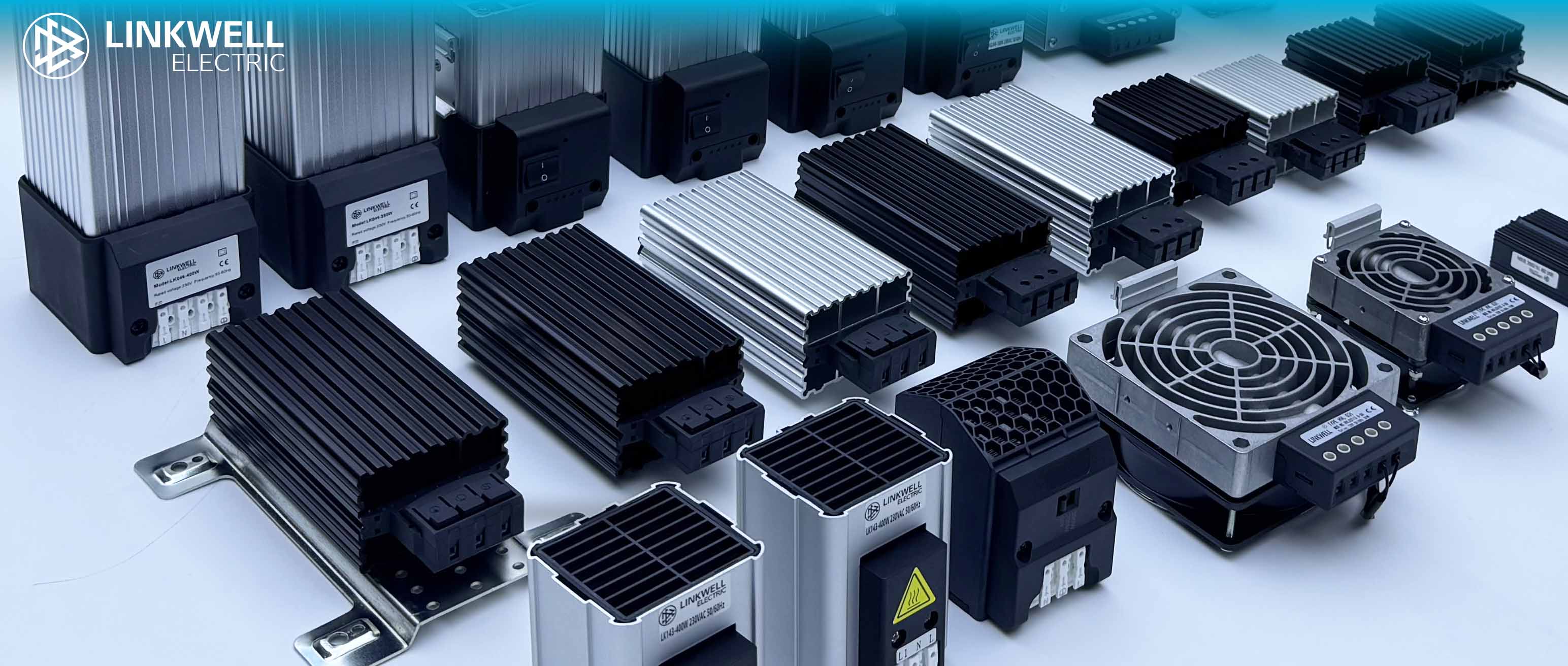
Compact and Flexible Installation: Small size (e.g., Linkwell LK140 series is only 70mm long) with high power density. Most designs support DIN rail snap-on mounting or screw fixing, making them ideal for space-constrained electrical control cabinets and chassis interiors.
-
Wide Voltage Compatibility: Typically designed for wide-range AC/DC input (e.g., 110-250V), insensitive to grid fluctuations, providing stable heat output.
Disadvantages
-
Limited Single-Unit Power: Due to material and heat dissipation constraints, the power of a single PTC fan heater usually does not exceed 150W-200W (e.g., Linkwell LK140 max 150W, LK145 max 200W). High-power requirements must be met by combining multiple units in parallel.
-
Higher Initial Cost: The manufacturing process and material cost of PTC ceramic chips are higher than those of ordinary resistance wire, resulting in a typically higher initial purchase price compared to traditional heaters.
-
Inrush Current at Cold Start: When starting from a completely cold state, the initial low resistance causes a relatively high instantaneous inrush current (usually 2-3 times the steady-state current), which must be considered in circuit design.
-
Power Affected by Environment: Its final equilibrium temperature is a balance between heat generation and dissipation. If the ambient temperature is too high or heat dissipation conditions are excellent (e.g., strong airflow), the actual maintenance power and temperature will adjust accordingly.
3. Industrial Standards for PTC Heaters
In demanding industrial environments, PTC heaters must comply with a series of strict standards to ensure safety, reliability, and compliance. Industrial-grade products, represented by series like Linkwell LK140/HG140, typically adhere to the following specifications:
| Specification Category | Specific Requirements & Standards | Explanation & Significance |
|---|---|---|
| Electrical Safety Standards |
Rated Voltage: AC/DC 110-250V (Wide-range design) Insulation Resistance: >100 MΩ @500VDC Clearance & Creepage Distance: Complies with IEC/EN 60529 |
Ensures stable operation in fluctuating grids, prevents leakage and breakdown, guarantees basic electrical safety. |
| Mechanical & Material Standards |
Housing Material: UL94 V-0 rated flame-retardant plastic (e.g., PPS/PPO) Heat Sink: Anodized extruded aluminum profile Protection Rating: Minimum IP20 (Protection against solid objects >12.5mm) |
Flame-retardant housing prevents fire spread; aluminum offers good heat dissipation; IP20 prevents finger contact with live parts. Outdoor or dusty environments require higher IP ratings (e.g., IP54/IP65) or protective covers. |
| Environmental Suitability Standards |
Operating Temp Range: -30℃ to +70℃ Storage Temp Range: -40℃ to +85℃ Humidity Range: 5% - 95% RH (non-condensing) |
Ensures reliable startup and operation in extreme high/low temperatures, suitable for most global industrial environments. |
| Performance & Certification Standards |
Temperature Stability: Typically fluctuates within ±5℃ of the Curie Point Safety Certifications: Must pass CE (EU), RoHS (Restriction of Hazardous Substances). Premium products have UL (USA), CSA (Canada) etc. |
CE is a legal requirement for the EU market; UL/CSA are widely recognized safety marks in North America, indicating independent third-party testing. |
| Installation Standards |
Mounting Method: Standard DIN EN 60715 TH35 rail mounting (snap-on) Wiring Method: Spring-cage clamp terminals or screw terminals |
Complies with universal industrial control cabinet standards for quick, secure installation and convenient, reliable wiring. |
4. Selection Guide and Application Examples
Four Key Selection Factors:
-
Determine Heating Power Requirement: Calculate the heat compensation needed based on cabinet volume, internal/external temperature difference, sealing level, and heat dissipation of internal components. If unsure, consult the supplier's selection software or charts.
-
Define Installation Space & Method: Measure available space and choose appropriate size and shape (long strip, square, etc.). Confirm if standard DIN rails are present inside the cabinet.
-
Assess Environmental Conditions: Is it dusty, humid, or exposed to corrosive gases? This determines the required Ingress Protection (IP) Rating. Outdoor applications require IP54 or higher.
-
Verify Compliance Requirements: Are there mandatory certification requirements for the project location or end customer (e.g., CE for EU, UL for USA)? Are there industry-specific standards (e.g., marine, rail)?
Typical Application Scenarios:
-
Electrical Control Cabinet Moisture & Condensation Protection: Prevents short circuits and corrosion caused by condensation. (Linkwell LK145 series with fan is particularly suitable for forced air circulation.)
-
Outdoor Telecom Base Stations / EV Chargers: Provides constant temperature protection for critical electronics in low-temperature environments.
-
Medical & Analytical Equipment: Provides stable, fluctuation-free temperature zones for precision sensors and reagent compartments.
-
Food Packaging Machinery: Prevents product contamination from condensation on conveyor belts or molds.
-
Rail Transit Vehicles: Used for low-temperature startup and anti-condensation in electrical compartments.
-
5. Frequently Asked Questions (FAQ)
Q1: Can PTC heaters be used directly in flammable or explosive environments?
A: Absolutely not. Standard industrial PTC heaters (even with IP65 housing) are not explosion-proof. In environments with flammable gases or dust (e.g., oil & gas, chemical, mining), explosion-proof PTC heaters certified for ATEX (EU), IECEx (International), or relevant Explosion-proof Certificates (China) must be used, and installed strictly according to explosion-proof specifications.
Q2: How to choose between a PTC heater with a fan (e.g., LK145) and one without (e.g., LK140)?
A: It primarily depends on heat dissipation needs and uniformity requirements.
-
LK140 (Fanless): Relies on natural convection. Suitable for small spaces, noise-sensitive areas, localized heating, or basic condensation prevention. Should typically be installed at the bottom of the cabinet.
-
LK145 (With Fan): Uses forced convection to quickly and uniformly raise the temperature throughout the entire cabinet, eliminating cold spots. Offers superior moisture and condensation prevention. Suitable for larger cabinets, widely distributed internal components, or situations requiring rapid heat-up.
Q3: Is the actual heat output of a PTC heater affected by ambient temperature?
A: Yes, this is inherent to its working principle. The rated power is typically measured at a standard ambient temperature of 20-25℃.
-
At lower ambient temperatures: Heat dissipates faster. To maintain the equilibrium temperature, the heater will operate in the high-power state for a longer period, potentially resulting in higher average power consumption.
-
At higher ambient temperatures: Closer to the target temperature, the heater will enter the low-power maintenance state sooner. The actual effective heat output will be lower. For selection, calculations should be based on the most severe low-temperature environment expected.
Q4: Can multiple PTC heaters be installed in one cabinet?
A: Yes, and this is often recommended. For large cabinets, installing multiple medium/low-power heaters at different locations (e.g., bottom and top) is more effective than installing a single high-power unit in one spot. This promotes more uniform temperature distribution, prevents local hot spots, and allows for further energy savings through zone control.